题目要求 1 2 3 4 5 6 7 8 9 10 Given two non-negative integers num1 and num2 represented as strings, return the product of num1 and num2. Note: 1. The length of both num1 and num2 is < 110. 2. Both num1 and num2 contains only digits 0-9. 3. Both num1 and num2 does not contain any leading zero. 4. You must not use any built-in BigInteger library or convert the inputs to integer directly.
将两个String形式的数字相乘的结果用String的形式返回。不准使用Int(java)以外的形式来记录数字。
思路一:队列 通过队列存储每一轮计算的结果。进行下一轮计算的时候,将上一轮的值deque出来加到当前的值上。
1 2 3 4 5 6 7 8 9 10 11 12 13 14 15 16 17 18 19 20 21 22 23 24 25 26 27 28 29 30 31 32 33 34 35 36 37 38 39 40 41 42 43 44 45 46 47 48 49 50 51 52 53 54 55 56 57 58 59 60 61 62 63 64 65 66 67 68 69 70 71 72 public String multiply (String num1, String num2) { if (num1.equals("0" ) || num2.equals("0" )){ return "0" ; } StringBuilder result = new StringBuilder (); LinkedList<Integer> queue = new LinkedList <Integer>(); int count = 0 ; if (num1.endsWith("0" )){ for (int i = num1.length() - 1 ; i>=0 ; i--){ if (num1.charAt(i) == '0' ){ count++; result.append("0" ); }else { break ; } } num1 = num1.substring(0 , num1.length()-count); } count = 0 ; if (num2.endsWith("0" )){ for (int i = num2.length() - 1 ; i>=0 ; i--){ if (num2.charAt(i) == '0' ){ count++; result.append("0" ); }else { break ; } } num2 = num2.substring(0 , num2.length()-count); } for (int i = num1.length()-1 ; i>=0 ; i--){ int number1 = num1.charAt(i) - '0' ; if (number1 == 0 ){ result.append(queue.removeFirst()); queue.add(0 ); continue ; } int carry = 0 ; for (int j = num2.length()-1 ; j>=0 ; j--){ int number2 = num2.charAt(j) - '0' ; int currentVal = number1 * number2 + carry + (i==num1.length()-1 ?0 :queue.removeFirst()); if (j== num2.length()-1 ){ result.append(currentVal % 10 ); }else { queue.add(currentVal % 10 ); } carry = currentVal/10 ; } queue.add(carry); carry = 0 ; } while (!queue.isEmpty() && queue.getLast() == 0 ){ queue.removeLast(); } while (!queue.isEmpty()){ result.append(queue.removeFirst()); } return result.reverse().toString(); }
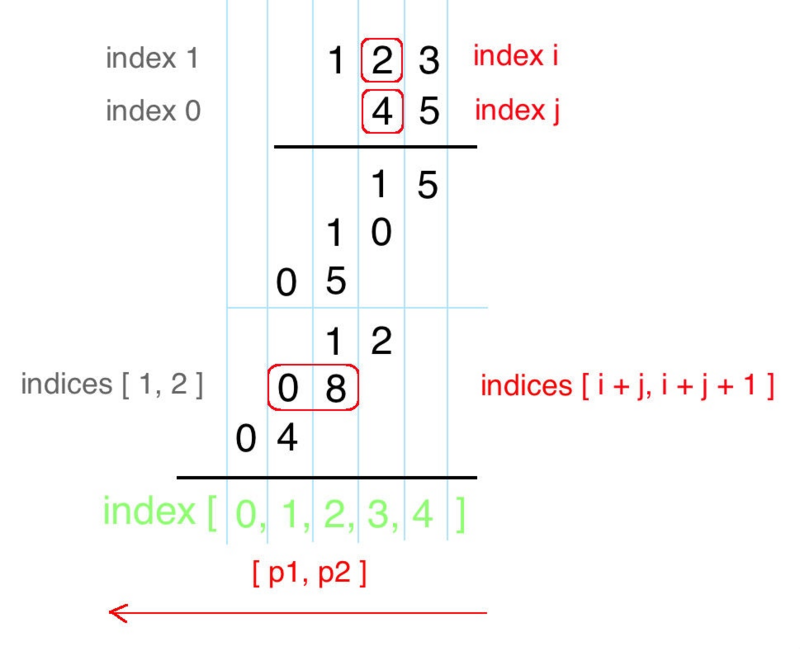
思路二:int数组存储 根据乘法计算的规则,我们可以判断两个值计算后应该填到哪一个位置上。假设num1[i]*num2[j],则将结果的十位和个位分别放在数组下标为i+j和i+j+1的位置上。记得计算的时候要加上上一轮的进位。
1
2
3
4
5
6
7
8
9
10
11
12
13
14
15
16
17
18
19
public String multiply (String num1, String num2) { int m = num1.length(), n = num2.length(); int [] pos = new int [m + n]; for (int i = m - 1 ; i >= 0 ; i--) { for (int j = n - 1 ; j >= 0 ; j--) { int mul = (num1.charAt(i) - '0' ) * (num2.charAt(j) - '0' ); int p1 = i + j, p2 = i + j + 1 ; int sum = mul + pos[p2]; pos[p1] += sum / 10 ; pos[p2] = (sum) % 10 ; } } StringBuilder sb = new StringBuilder (); for (int p : pos) if (!(sb.length() == 0 && p == 0 )) sb.append(p); return sb.length() == 0 ? "0" : sb.toString(); }
思路三:将计算和进位分开 这里将每一位的计算结果都先存储到当前位置上,不管是否进位。存储的位置等同于上一思路。然后再通过一轮遍历将进位处理一下。
1
2
3
4
5
6
7
8
9
10
11
12
13
14
15
16
17
18
19
20
21
22
23
24
25
26
27
28
29
public String multiply (String num1, String num2) { if (num1.isEmpty() || num2.isEmpty()) return "0" ; int m = num1.length(), n = num2.length(); int [] ret = new int [m+n]; for (int i = m-1 ; i >= 0 ; i--) { int n1 = num1.charAt(i)-'0' ; for (int j = n-1 ; j>=0 ; j--) { int n2 = num2.charAt(j)-'0' ; int mul = n1*n2; ret[i+j+1 ] += mul; } } int carryOver = 0 ; for (int i = ret.length-1 ; i>=0 ; i--) { ret[i]+=carryOver; carryOver = ret[i]/10 ; ret[i]%=10 ; } StringBuilder sb = new StringBuilder (); for (int x : ret) { if (x == 0 && sb.length()==0 ) continue ; sb.append(x); } return sb.length()==0 ?"0" :sb.toString(); }