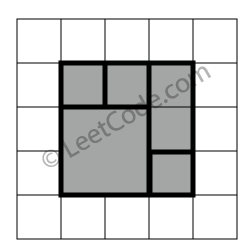
题目要求 1 2 3 4 5 6 7 8 9 10 11 12 13 14 15 Given N axis-aligned rectangles where N > 0, determine if they all together form an exact cover of a rectangular region. Each rectangle is represented as a bottom-left point and a top-right point. For example, a unit square is represented as [1,1,2,2]. (coordinate of bottom-left point is (1, 1) and top-right point is (2, 2)). Example 1: rectangles = [ [1,1,3,3], [3,1,4,2], [3,2,4,4], [1,3,2,4], [2,3,3,4] ] Return true. All 5 rectangles together form an exact cover of a rectangular region.
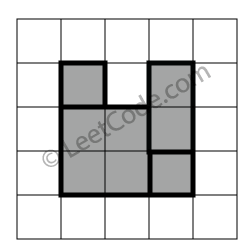
1 2 3 4 5 6 7 8 9 10 Example 2: rectangles = [ [1,1,2,3], [1,3,2,4], [3,1,4,2], [3,2,4,4] ] Return false. Because there is a gap between the two rectangular regions.
1 2 3 4 5 6 7 8 9 10 Example 3: rectangles = [ [1,1,3,3], [3,1,4,2], [1,3,2,4], [3,2,4,4] ] Return false. Because there is a gap in the top center.
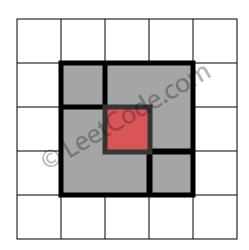
1 2 3 4 5 6 7 8 9 10 Example 4: rectangles = [ [1,1,3,3], [3,1,4,2], [1,3,2,4], [2,2,4,4] ] Return false. Because two of the rectangles overlap with each other.
用一个二维数组来表示一堆矩形,二维数组中的每一行分别记录矩形左下角和右上角的坐标。试判断这些矩形拼接成的新的图形是否还是一个矩形。如果矩形存在重合,则不构成矩形,见图例4.
思路和代码 这是一道纯粹的考验思维的一道题目。
其次,光判断面积并不足够,可以这样三个矩形构成的图形[1,1,2,2],[2,2,3,3],[2,1,3,3]。可以看到该图形的理想矩形就是一个2*2的正方形,它的面积与所有的小矩形的和相等,但是这些小矩形并没有构成该理想的矩形。那么我们能用什么方式来过滤掉这种矩形呢。只能从矩形的顶点入手了。
代码如下:
1 2 3 4 5 6 7 8 9 10 11 12 13 14 15 16 17 18 19 20 21 22 23 24 25 26 27 28 29 30 31 32 33 34 35 36 37 38 39 40 41 public boolean isRectangleCover (int [][] rectangles) { if (rectangles==null || rectangles.length == 0 || rectangles[0 ].length == 0 ) return false ; int areaSum = 0 ; int x1 = Integer.MAX_VALUE; int x2 = Integer.MIN_VALUE; int y1 = Integer.MAX_VALUE; int y2 = Integer.MIN_VALUE; Set<String> points = new HashSet <>(rectangles.length * 4 ); for (int [] rectangle : rectangles) { x1 = Math.min(rectangle[0 ], x1); x2 = Math.max(rectangle[2 ], x2); y1 = Math.min(rectangle[1 ], y1); y2 = Math.max(rectangle[3 ], y2); areaSum += (rectangle[0 ] - rectangle[2 ]) * (rectangle[1 ] - rectangle[3 ]); String s1 = rectangle[0 ] + " " + rectangle[1 ]; String s2 = rectangle[0 ] + " " + rectangle[3 ]; String s3 = rectangle[2 ] + " " + rectangle[1 ]; String s4 = rectangle[2 ] + " " + rectangle[3 ]; if (!points.add(s1)) { points.remove(s1); } if (!points.add(s2)) { points.remove(s2); } if (!points.add(s3)) { points.remove(s3); } if (!points.add(s4)) { points.remove(s4); } } if (!points.contains(x1 + " " + y1) || !points.contains(x1 + " " + y2) || !points.contains(x2 + " " + y1) || !points.contains(x2 + " " + y2) || points.size() != 4 ) return false ; return areaSum == (x2 - x1) * (y2 - y1); }